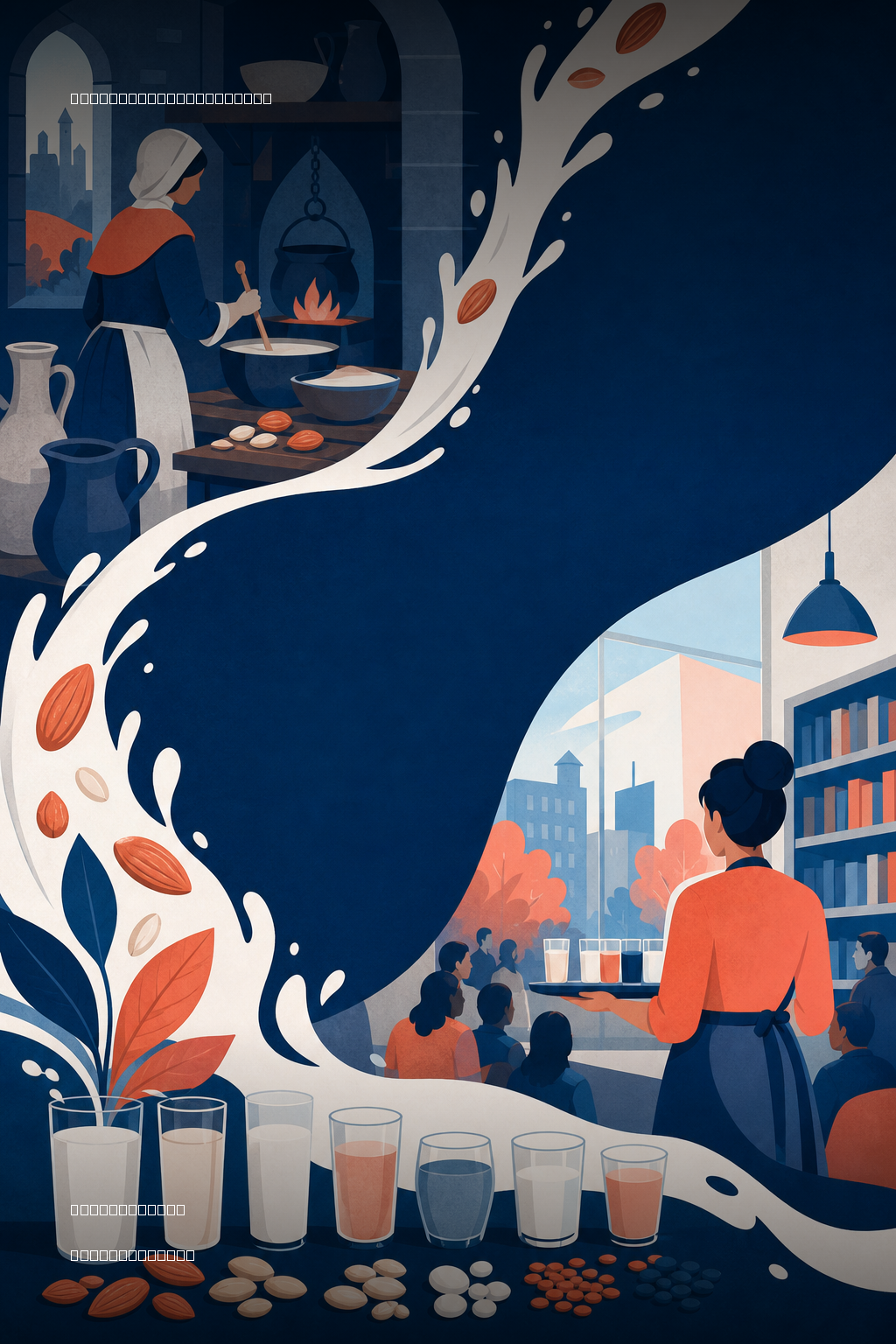
Chapter 3
Best for What?
By nine Saturday morning, the museum courtyard smelled of coffee, wet cardboard, and six cartons pretending to belong together.
Mara had spent three weeks persuading Valley Harvest Market to sponsor the tasting. After last spring’s cannery exhibit drew eleven visitors—three cousins—the promised ad and photograph felt like proof she could fill a courtyard.
The photographer raised his camera. “Give me a winner. Mara holds it up, people see the ad, everyone conquers breakfast.”
Mara eyed the chalkboard: MILK THROUGH TIME: PICK A CHAMPION.
— People enjoy conquest.
— They also enjoy not being served an allergen, said Dev, arriving with cards.
At registration, a woman touched the lactose-free dairy carton. “My sister has a milk allergy. Is this safe?”
Mara looked to Dev.
— It is still dairy, Dev said. For milk-protein allergy, we can’t decide for your sister. Ingredient and allergen information are here; she should follow her clinician’s guidance.
A man asked, “If someone is allergic to one tree nut, does that mean all tree nuts?”
— Not automatically. That’s individual medical territory, not museum territory.
Dev’s mouth twitched. “She has learned restraint. Mark the date.”
Then the pouring-table volunteer lifted the almond carton. Damp had curled his color stickers; he reached for a blue cup.
— Stop.
He froze.
— We reset. That cup goes out. New gloves, clean surface, new cup.
— I only—
— The system made the mistake easy, Mara said. That is on the system.
Almond was clearly declared, but an allergen could travel by hand, counter, cup, or careless inches. “May contain” warnings mattered, Dev had told her, but were not one official safety code.
— We’re delaying service, Mara announced. Thank you for waiting while we make it safer.
The photographer checked his watch. Ms. Bell, the market manager, pressed her lips together.
— Our ad deadline is Monday. The point was a cheerful winner photo.
Mara imagined fall publicity disappearing, another thin crowd to explain to her director. Then she erased PICK A CHAMPION.
— Dev, I need the cards in the order people arrive confused, not nutrition order.
— You’re directing now?
— I’m asking you to trust the story part.
He handed her the stack. “Tell the story.”
Together they made a path: Need protein? Avoid lactose? Avoid milk proteins? Avoid tree nuts? Checking added sugars?
Full explanations stayed on printed cards, safe from toddlers and camera deadlines.
At the protein card, a father paused with his son. Dev started forward, then stopped as Mara lifted the matched-serving-size card.
— For this child’s breakfast, compare protein first. This fortified soy carton fits that need better than almond today. Check the label if you buy another brand.
At the almond table, a woman chose unsweetened after reading the Nutrition Facts. “I wanted dairy-free, not much protein.”
— Then it may be a good fit.
Across the courtyard, Elena stood among irrigation tubing, orchard photographs, and bees dusted with pollen.
— No moral trophy, she told a visitor asking which milk was ethical. Broad comparisons can favor plant beverages over dairy for land and climate impact. But almonds raise water questions, and water differs by place. This orchard makes irrigation decisions every day. Bees work here too.
The visitor reread the sign rather than taking a photograph. Elena counted that as victory.
At noon, after cleaning and reopening, Mara served tiny spoons of pale fasting pottage beneath a label:
MEDIEVAL-INSPIRED ALMOND COOKING LIQUID
HAND-GROUND AND STRAINED. NOT A MODERN CARTON BEVERAGE.
Beside it lay a copied seventeenth-century recipe, To make good Almond Milk, with sugar, rosewater, and repeated straining.
— This recipe is later than the household record inspiring this dish, Mara told the group. The older record only notes almonds issued for fasting pottage in a prosperous household. The rest is researched reconstruction, not one woman’s thoughts.
She did not say Alis saved the solids. She could not know that.
But centuries earlier, Alis stood at a hearth as the steward tasted pottage from a silver spoon.
He demanded richness without more almonds. She answered with patience: smoothest strained liquor for the pot, spice, salt enough to wake flavor. The remaining paste she mixed with crumbs and herbs, shaping fried cakes for the lower table.
— Better, said the steward. Tell the mistress the almonds served well.
— Tell her the kitchen made them serve, Alis said.
Young Kit stopped staring at the floor.
— The cakes. Carry them out. Say they are from my board, so no one throws them away.
— Yes, Alis.
The steward turned toward the hall. He did not object. In kitchens, that was near enough to permission.
By late afternoon, Ms. Bell left without her champion photograph. She promised no fall ad, only a smaller newsletter listing “if there was room.” Mara watched the photographer pack and felt the loss settle in her stomach.
But people remained. They read, compared, chose.
After the last cups were cleared, Dev offered chalk.
Mara wrote:
BEST FOR WHAT—AND FOR WHOM?
— I thought nuance meant I’d failed to defend almond beverage.
— You defended people’s ability to choose.
— That is annoyingly better.
— I know. Your story did the work. I brought rectangles of information.
— You brought the brakes.
— And you used them before the wall.
That evening, Mara placed the later recipe beside her note on the older household record and new comparison cards. Not proof that old almond cooking liquid and a modern carton were the same.
Only evidence that almonds, like arguments, did different work in different hands.